




Housing Affordability and Submarket Trends
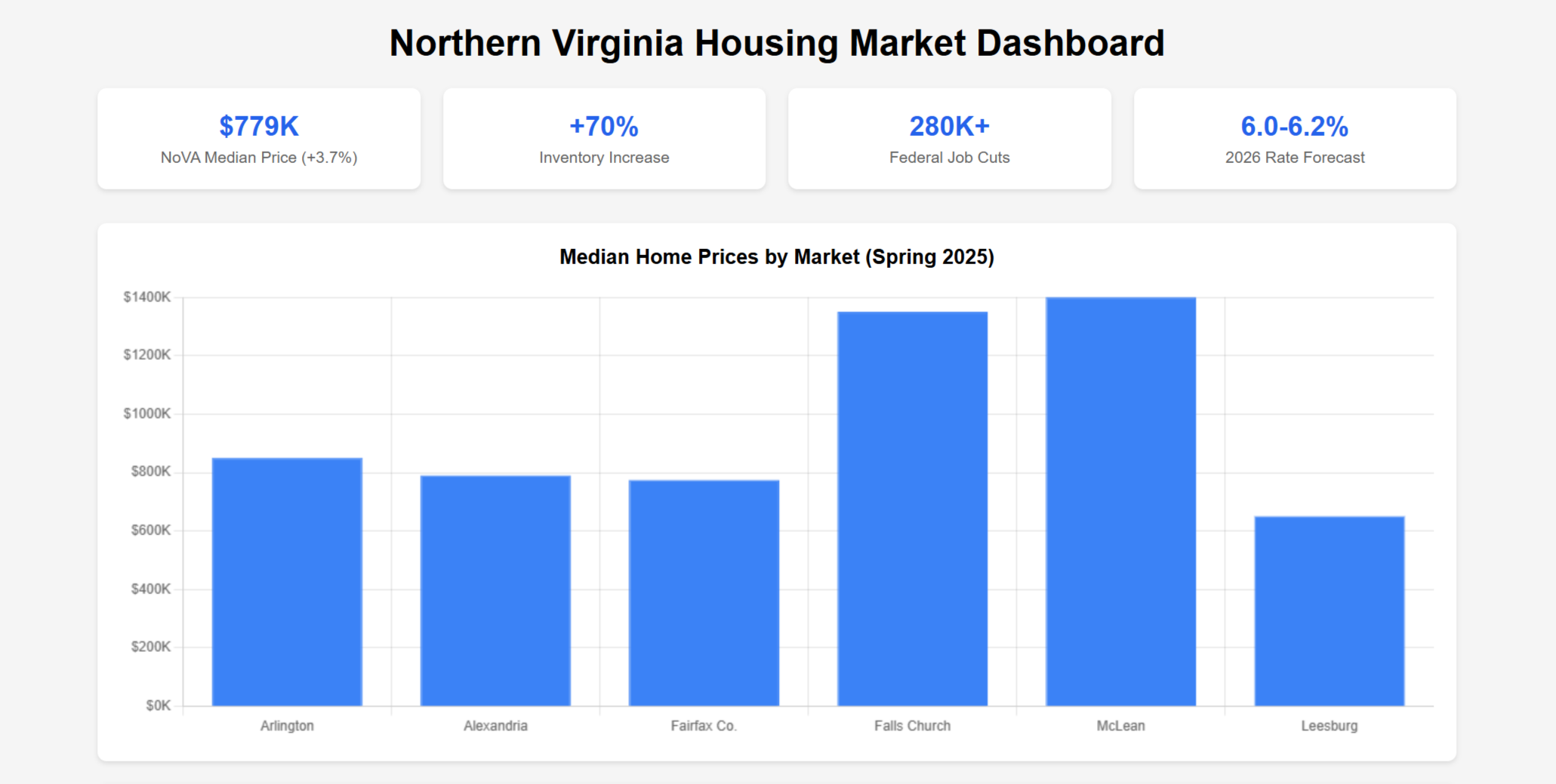
Northern Virginia's real estate market remains expensive but mixed across its subregions. Close-in areas like Arlington, Alexandria, and North Arlington (Clarendon–Ballston corridor) command high prices, while outer locations offer slightly more relief. As of spring 2025, Arlington's median home sale price hovered around the mid-$800Ks (nearly double the U.S. average) redfin.com, whereas Alexandria City's median was about $790K after a 9% annual jump marketminute.longandfoster.com. Fairfax County – the region's largest market – sits in between, with a median price of roughly $774K redfin.com. In ultra-prime enclaves like Falls Church City or McLean, typical prices top $1.3–$1.4 million, reflecting a recent 17% surge northernvirginiamag.com.
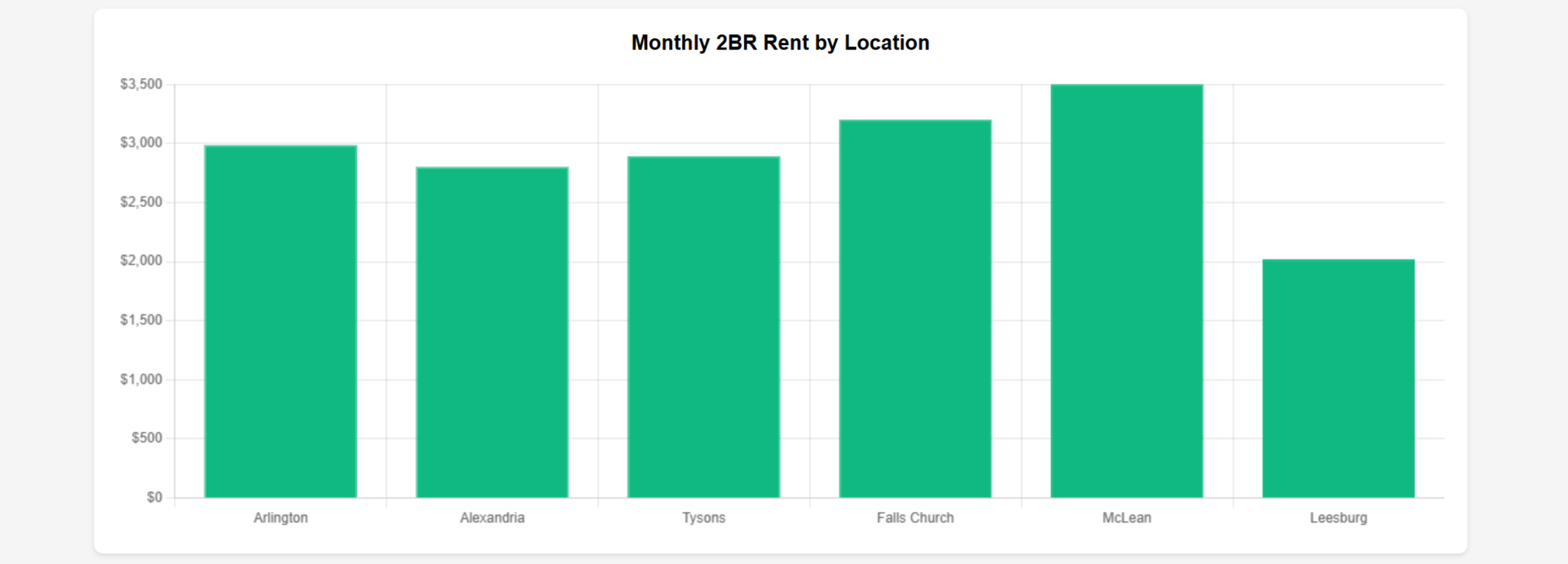
These price levels rank among the highest in the nation and create major affordability challenges ffxnow.com, especially for first-time buyers and young families. Rents remain elevated as well, often rivaling or exceeding mortgage payments. The chart below highlights the stark differences in median home prices and monthly rents across several Northern Virginia submarkets.
For example, Arlington's median two-bedroom rent is nearly $3,000 per month, versus about $2,000 in outer areas like Leesburg northernvirginiamag.com. Region-wide, rents have risen about 2–5% over the past year northernvirginiamag.com, despite a slight national dip. As of March 2025, median 2BR rents stood at $2,985 in Arlington, $2,890 in Tysons (Fairfax), and $2,019 in Leesburg, reflecting how proximity to job centers drives up housing costs northernvirginiamag.com.
Such rent levels mean many households are spending well above the recommended 30% of income on housing, squeezing budgets and making it harder to save for a home purchase ffxnow.com. In short, affordability is stretched: buyers face high prices and interest rates, while renters contend with historically high rents – a dynamic unlikely to change dramatically by 2026 without significant shifts in supply or policy.
Employment Shakeups and Economic Uncertainty
A wave of employment disruptions in 2025 is adding uncertainty to Northern Virginia's outlook. The federal government – a pillar of the D.C.-area economy – is undergoing mass retirements and layoffs under the new administration's efficiency push. President Trump's Department of Government Efficiency (DOGE), led by Elon Musk, has moved rapidly to slash federal jobs, with plans to eliminate or lay off over 280,000 federal workers and contractors across 27 agencies govexec.com.
Early 2025 saw drastic cuts: for instance, the Department of Education proposed cutting nearly half its workforce, Veterans Affairs targeting an 80,000 staff reduction, and Social Security offering buyouts ahead of a reduction in force npr.org. Tens of thousands of newer federal employees were summarily fired (though courts have since ordered many reinstated) npr.org. Additionally, DOGE's "Fork in the Road" voluntary retirement program enticed 75,000 federal workers to resign by February 2025 govexec.com – a rush of retirements that in many cases removes long-time homeowners (or would-be home buyers) from the local market.
Contractors are feeling the pain too: at least 13 government contractors announced 2,425 layoffs in Northern Virginia and Maryland by April washingtontechnology.com due to canceled projects and agency closures. Notably, the shutdown of entire agencies like USAID has devastated contractors such as DAI Global and Chemonics (500+ layoffs each) washingtontechnology.com. This GovCon turmoil hits local housing demand on multiple fronts – from furloughed workers unable to obtain mortgages to suddenly unemployed renters considering cheaper cities.
The tech sector, another regional employer (e.g. Amazon's HQ2 in Crystal City/Pentagon City), is also tapping the brakes. Big Tech nationwide went through major layoffs in 2023–24, and hiring remains slow in 2025 amid higher interest rates and market uncertainties washingtonpost.com. Amazon, for example, added only a few hundred HQ2 jobs last year and even shrank its Arlington headcount in 2023 washingtonpost.com. It has lowered its job growth forecasts and paused new construction – dampening hopes that HQ2 would cushion the region from federal cutbacks washingtonpost.com.
High-paying private-sector jobs are needed to offset public-sector losses, but so far gains in tech and other industries aren't fully making up the difference washingtonpost.com. In the first quarter of 2025 alone, over 6,500 D.C.-area workers filed unemployment claims due to layoffs – a rate exceeding even the pandemic's impact washingtonpost.com.
All these employment headwinds create uncertainty for housing: some households may relocate or downsize after a job loss or early retirement, while others grow more cautious about big purchases. Buyer sentiment tends to deteriorate with job insecurity. Indeed, local economists call this a "perfect storm" of public and private cutbacks, warning that the traditionally stable Washington economy is being dragged down in a way not seen in decades washingtonpost.com. The silver lining is that Northern Virginia entered this period with pent-up housing demand and low inventory, so a moderate dip in demand may simply move the market toward balance rather than glut arlnow.com. Still, the employment outlook will be a key factor to watch into 2026 – housing forecasts here are now tightly linked to government workforce policies and the region's ability to attract new jobs.
Return-to-Office Mandates and Commute Shifts
Adding to the upheaval is a sweeping return-to-office (RTO) mandate for federal employees and many private-sector workers. In one of his first acts in January 2025, President Trump ended remote work for all federal agencies via executive order wtop.com. This abrupt mandate has created chaos at offices – and on the roads. Federal staffers ordered back found many offices unprepared, with shortages of desks, equipment, even toilet paper, and confusion over workspace assignments (one agency infamously told an employee to report to a storage unit by mistake) npr.org.
Many employees suspect the harsh RTO push is intended to encourage more resignations, especially since it reverses years of pro-telework policy and comes alongside mass firings npr.org. Unions are challenging the mandate, and 30% of the federal workforce is eligible to retire – a chunk who might choose retirement rather than endure a grinding commute every day wtop.com. In fact, local experts predicted a "retirement surge" if one-size-fits-all telework elimination went through wtop.com.
We are indeed seeing some of that: traffic data show D.C.-area congestion is back to pre-pandemic levels even with only ~50% of offices filled so far wtop.com. As tens of thousands more federal and contractor employees resume daily commuting, highways are likely to clog further – a stark change from the lighter traffic of the remote-work era.
Housing location preferences are shifting under these pressures. During the pandemic, many workers moved farther out (even to West Virginia or beyond) to find affordable homes, counting on telework. Now, those with long commutes face tough choices: relocate closer in, or leave their job/leave the region wtop.com ffxnow.com. Real estate agents report renewed interest in walkable, transit-accessible neighborhoods (e.g. Clarendon, Ballston, or Del Ray) as people try to minimize commute times.
Demand for condos and townhomes in Arlington and Alexandria – suppressed in the remote-work era – has started to rebound, with Amazon HQ2 employees and federal workers alike returning to in-person schedules (Amazon now requires 5 days on-site for its 8,300 HQ2 staff) washingtonpost.com. Meanwhile, some outer suburbs could see softening demand if remote workers retreat: exurban counties benefited from the COVID migration, but that trend is slowing or reversing for federal employees ffxnow.com.
All told, return-to-office mandates are making proximity matter again. We anticipate increased housing competition in Metro-adjacent areas (despite higher prices) as commuting costs – both time and money – weigh on workers. On the flip side, if many federal workers opt for early retirement rather than relocation, the region could see a wave of downsizing sales (long-time owners listing homes) or simply fewer paychecks contributing to housing demand. The ultimate impact will depend on how strictly RTO is enforced and whether agencies allow any flexibility.
For now, the daily influx of commuters is undeniably up, and policymakers are urging greater transit use to mitigate gridlock wtop.com. This return of congestion could incrementally boost the appeal of urban villages like Crystal City (with its new shops and offices) and discourage long suburban commutes, subtly reshaping the housing landscape in late 2025 and beyond.
Inventory, Migration, and Supply–Demand Balance

After two years of extreme housing scarcity, inventory is finally rising in Northern Virginia. By spring 2025, the number of homes on the market was up nearly 70% compared to a year prior northernvirginiamag.com. In April 2025, about 2,508 active listings were on the market (vs. ~1,480 in April 2024), with almost 2,000 new listings coming on during the month northernvirginiamag.com.
This influx of supply – partly seasonal, partly due to more sellers gaining confidence – led to slight dips in sales volume (home sales were down ~2–3% year-over-year) northernvirginiamag.com. Notably, Arlington and Alexandria saw 9–13% fewer sales than the previous spring, while smaller markets like Falls Church and Fairfax City actually had an uptick in transactions northernvirginiamag.com.
Prices, however, are still rising modestly. The median sale price across Northern Virginia was about $779,000 in April (up ~3.7% YoY) northernvirginiamag.com, and every locality posted annual price gains northernvirginiamag.com. In short, higher inventory is easing the frenzy but not causing outright price declines.
The Northern Virginia Association of Realtors (NVAR) notes this supply increase "signals a step toward a more balanced market," where buyers have more choices and slightly more negotiating power northernvirginiamag.com. Homes now sit a bit longer and bidding wars are less common than in 2021–22. Indeed, buyers in mid-2025 are often able to submit offers with contingencies or below list price – something almost unheard of a year ago – while sellers must price strategically and put effort into staging to attract bids northernvirginiamag.com.
One factor influencing inventory is the possibility of a regional exodus – or at least a reshuffling of residents. High housing costs and recent policy moves have led to some out-migration. Young families in particular are leaving NoVA in search of affordable living. Between 2018 and 2022, the region saw a significant net outflow of adults aged 25–44, along with a net loss in income as higher earners moved out and were replaced by lower-earning in-migrants ffxnow.com.
This "brain drain" is tied directly to housing prices: a recent report highlights that without plentiful hybrid work options or new affordable homes, Northern Virginia will struggle to retain highly educated young professionals as they form families ffxnow.com. Many are choosing to settle further out – for example, in Spotsylvania County, VA (+56% migration) or Frederick County, VA (+49%) – or outside the metro entirely ffxnow.com.
At the same time, the overall population isn't collapsing; it's just shifting. Some closer-in areas (Arlington, etc.) still show population growth due to international immigration and other factors washingtonpost.com, even as they experience small domestic outflows. For housing, this means demand is cooling at the margins rather than falling off a cliff. We might see a bit more listing activity from outbound families (increasing supply), counterbalanced by incoming buyers from elsewhere or renters ready to buy (keeping demand alive).
Importantly, the huge federal layoffs and RTO-driven retirements discussed above could amplify out-migration. If thousands of former federal employees decide to relocate to cheaper states for retirement or new jobs, the region could see a spike in home listings – potentially tilting the market in buyers' favor by late 2025. So far, though, the data shows resilience: most laid-off workers have stayed put or found local opportunities, and any uptick in listings has been met by persistent buyer interest. Northern Virginia's housing supply and demand are moving toward equilibrium, but the balance is delicate and could tip if an exodus accelerates. We will be monitoring listing trends closely into 2026.
Interest Rates and Mortgage Affordability
Buyers and sellers should pay keen attention to the interest rate outlook going into 2026. After 2022's rapid run-up, mortgage rates remain relatively high – generally 6% to 7% for a 30-year fixed loan in 2025 freddiemac.com. This has put a damper on affordability: a $700K home with 20% down easily carries a $4,000+ monthly mortgage payment at today's rates, pricing many buyers out.
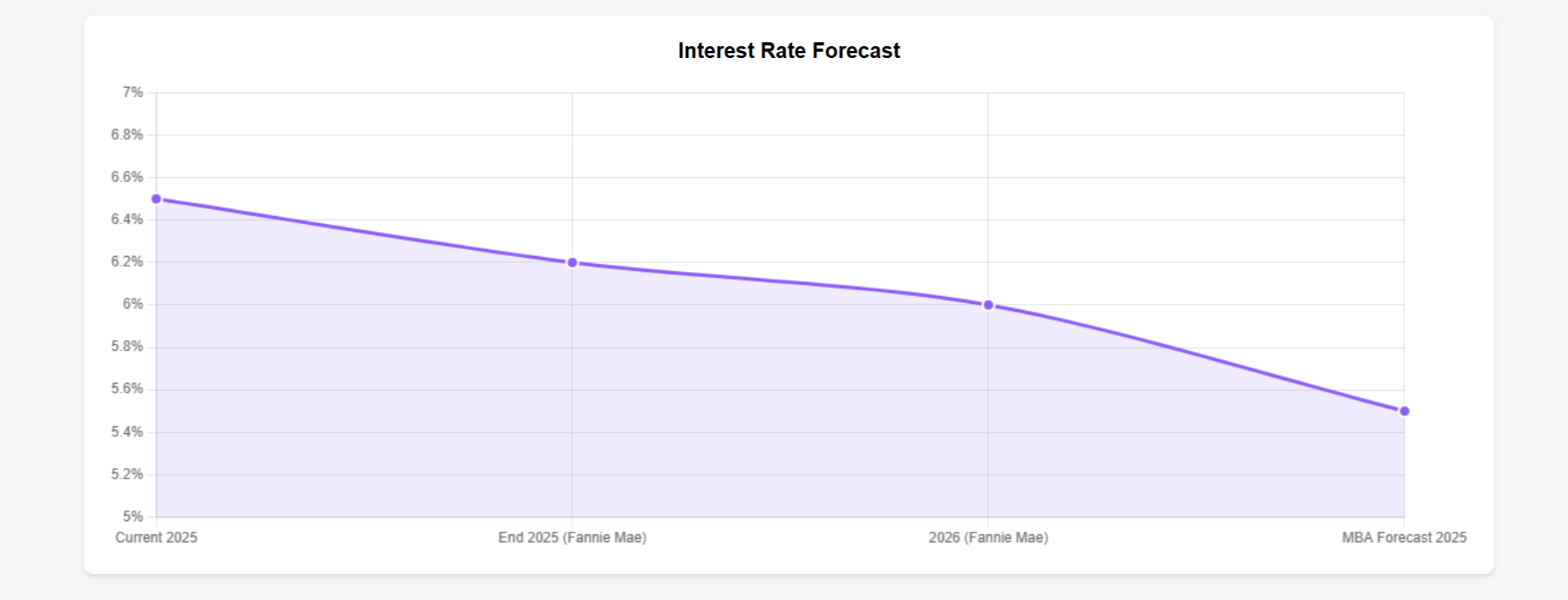
The good news is that most forecasts see rates gradually easing over the next year. Fannie Mae's latest outlook (April 2025) predicts 30-year mortgage rates will edge down to ~6.2% by end of 2025 and ~6.0% in 2026 forbes.com. The Mortgage Bankers Association is even more optimistic, forecasting rates in the mid-5% range by late 2025 under their baseline scenario mba.org.
If inflation continues to cool and the Federal Reserve cuts benchmark rates as expected in 2024–25, mortgage rates should indeed drift lower – though likely not back to the ultra-low ~3% levels of 2020–2021. Homebuyers can therefore expect slightly better financing conditions in 2026, which could expand budgets or bring some fence-sitters into the market. For sellers, a rate drop would be welcome news, potentially enlarging the buyer pool.
However, in the near term, affordability remains a serious hurdle. Mortgage rates below 7% are still double what they were a few years ago, and prices haven't fallen to compensate. That's why Northern Virginia's home sales in 2023–25 have been sluggish despite strong household formation – many would-be buyers simply can't make the numbers work.
Compounding this, a lot of current homeowners are "locked in" to rock-bottom rates and thus reluctant to sell and give up their 3% loan arlnow.com. This rate lock-in effect limits fresh inventory coming to market (people stay put), but it also means new construction and first-time buyers carry the load of higher interest costs.
Buyers who are stretching should run scenarios for both best-case and worst-case rates in 2026 and consider adjustable-rate mortgages or buydowns if appropriate. On the flip side, if the economy falters (given the government cuts), the Fed might slash rates faster – but that could be accompanied by a tougher job market, so it's a double-edged sword.
Our outlook assumes a moderate rate decline going into 2026, which would slightly improve affordability and perhaps stimulate demand. Yet any gains from lower rates could be offset if prices don't moderate. Mortgage affordability will remain tight unless both inputs – home prices and interest rates – move favorably.
Savvy buyers should watch for refinance opportunities in late 2025–2026 if rates dip, and sellers might time listings to catch the wave of buyers re-entering as financing gets easier. In sum, plan for mortgage rates in the mid-6s for 2025 and hope for low-6s or high-5s in 2026, and budget accordingly forbes.com mba.org.
Rent Trajectory and the Rental Market
Will rents finally cool off? That's a pressing question for 2025–26. Rents across Northern Virginia jumped sharply in 2021–22 and hit record highs in 2023, straining many tenants. Coming into 2024–25, there were signs of moderation: rent growth slowed as new apartment supply came online and some renters left the region. Indeed, nationwide rents even dipped slightly (~0.4% YoY) in early 2025 northernvirginiamag.com.
However, the D.C. metro (and NoVA in particular) bucked the trend with continued rent increases. As of March 2025, median rents in the D.C. area were up ~2.3% year-over-year northernvirginiamag.com, and Northern Virginia submarkets like Annandale, Woodbridge, and Arlington saw annual rent spikes of 5–10% northernvirginiamag.com.
Why are local rents still rising? In part because the region's housing shortage hasn't gone away – even if more people are leaving, those who remain are competing for limited units. Additionally, some would-be homebuyers remain renters due to high interest rates, keeping rental demand robust. Job losses in 2025 have yet to translate into higher vacancy rates; many displaced federal/contractor employees are receiving severance or dual incomes (or they simply haven't moved out yet), so the rental market remains tight in desirable areas.
Looking ahead, we expect rent growth to flatten or slow modestly but not dramatically drop. The apartment industry and analysts forecast modest positive rent growth in 2025 as the market finds equilibrium northernvirginiamag.com. For instance, Apartment List notes that after a brief lull, rents in 2025 are "likely to return to positive year-over-year growth, but…modest" northernvirginiamag.com.
Northern Virginia's pipeline of new multifamily projects (in places like Tysons, Reston, and along Metro corridors) should gradually boost supply and could temper rent increases. Also, if more people do leave the region or consolidate households due to economic uncertainty, vacancies may tick up in older or less convenient rentals, forcing landlords to be more competitive.
We're already seeing rent price divergence: outer areas like Leesburg and Centreville have some of the fastest rent growth (catching up from a lower base) northernvirginiamag.com, while core areas like D.C. proper saw only ~1–2% rent increases last year axios.com. This suggests some price ceiling is being reached in the priciest neighborhoods – renters simply can't absorb much more.
Our forecast: Rents will remain high through 2025, perhaps rising in the low single digits percentage-wise. By 2026, if job and population trends warrant, we may see a few submarkets with flat or even declining rents (for example, luxury high-rise apartments in Crystal City could offer concessions if Amazon hiring slows). But overall, no steep rent crash is expected absent a major recession.
Renters should budget for current rents to persist, and landlords should expect more tenant pushback and longer listing times if they try to hike prices aggressively. One wildcard: any local or federal housing legislation (rent control measures, incentives for affordable housing, etc.) could affect the rent trajectory, though none are certain at this stage. In sum, anticipate a plateauing of rents at elevated levels, which, while not great news for renters, at least beats the 10%+ annual jumps seen in the recent past.
Policy and Legislative Wildcards (e.g. "One Big Beautiful Bill")
Government policy will continue to play a pivotal role in Northern Virginia's housing climate. The most prominent wildcards are major federal legislative packages – chief among them "The One Big Beautiful Bill" (OBBB), a massive reconciliation bill championed by Trump that seeks to overhaul federal spending and taxes. As of May 2025, this 1,116-page bill had stalled amid infighting, failing its House Budget Committee vote newsfromthestates.com.
The OBBB contains hundreds of billions in budget cuts (targeting everything from Medicaid to green energy credits) and measures to "right-size government" in line with Trump's vision newsfromthestates.com. If some version of this bill eventually passes, the local impact could be significant. Deep spending cuts could mean additional federal layoffs or contractor pullbacks beyond those already enacted, further squeezing the regional economy. For instance, OBBB as written was described as taking a "wrecking ball" to Medicaid and other safety nets newsfromthestates.com – which not only has social implications but also potentially shrinks health-related federal offices and contractors in the area.
The bill also bundled in Trump's desired tax cuts; while lower taxes can put a bit more cash in some residents' pockets, the greater effect locally might be higher federal deficits leading to pressure on interest rates. If markets perceive fiscal instability or an increased debt load from OBBB, it could keep mortgage rates higher for longer – an indirect but real influence on housing affordability.
On the flip side, failure to pass the OBBB (or delays in the budget process) could lead to government shutdown threats or stop-gap funding, which create their own headwinds. Even the attempts to implement these policies have introduced uncertainty: contractors have faced stop-work orders and delayed payments as agencies scramble under new directives npr.org washingtontechnology.com.
For housing, uncertainty tends to make both buyers and sellers more cautious. We saw this in late 2024 during a brief federal funding lapse – some home sales fell through as furloughed buyers lost their income verification, and listing activity dipped until confidence was restored.
As we approach 2026, the political climate (in a presidential election year) could be tumultuous. Potential new legislation on the horizon might include a follow-up reconciliation bill if OBBB fails, or perhaps infrastructure spending that could benefit the region's transit and construction jobs. Local measures, too, bear watching: e.g. zoning reforms to allow more housing density in Fairfax or Arlington would be a positive for supply, though those are in early discussion stages.
In summary, policy changes are a swing factor for this forecast. The aggressive federal downsizing and any major budget laws will directly affect local employment and income, thereby impacting housing demand. They also influence sentiment: a stable policy environment could restore confidence to move up or invest in property, whereas continued turmoil might make buyers delay decisions.
Both buyers and sellers should stay alert to D.C. legislative news, as the passage (or blocking) of big bills can quickly alter mortgage rates, job security, and even specific housing-related provisions (like tax deductions for property taxes or mortgage interest, which Congress occasionally tweaks). Right now, Northern Virginia is navigating uncharted waters with a reform-minded federal administration – housing players need to be nimble and informed.
Post-Spring 2025: What to Expect for Buyers and Sellers

As we move past the spring 2025 selling season and into late 2025 and 2026, the Northern Virginia market is transitioning toward balance. For the first time in years, buyers have reason for cautious optimism – inventory is improving and competition is less frenzied – while sellers face a more normalized market that rewards proper pricing and property condition. Below are actionable insights for both home buyers and sellers in the coming 12–18 months:
For Home Buyers
You'll find more choice and leverage than in recent years. Active listings in NoVA are up ~70% year-over-year northernvirginiamag.com, which means you can afford to be picky and avoid extreme bidding wars. Take advantage of the growing inventory by shopping around in different neighborhoods – areas like Fairfax County now have a variety of options, from condos to single-families, as inventory climbs toward a 2+ month supply (more balanced conditions) marketminute.longandfoster.com.
With fewer bidding wars, you may be able to include inspection or financing contingencies again and negotiate on price or seller concessions (especially for homes that have sat on the market >30 days). That said, be prepared for continued high monthly payments – run your numbers at today's ~6.5% rates and consider that prices are still edging up modestly. If you're renting and hoping to buy, keep an eye on interest rate trends; a small drop in rates by late 2025 could meaningfully improve your budget.
And don't overlook commute factors – if you're now expected in the office, a home in Arlington or close to Metro might save you hours of traffic (time is money). Overall, approach the market methodically: get pre-approved, expect realistic prices (no fire sales yet), but know that you have a better shot at finding a home without foregoing all contingencies or going way over asking. Patience and homework in this environment can pay off.
For Home Sellers
The days of frenzied demand and instant sales are largely over, so a strategic approach is key. Homes are still selling – median prices are up year-over-year northernvirginiamag.com – but buyers are more discerning and have more alternatives now. To stand out, price your home competitively from the start. Overpricing is likely to backfire in a cooling market; buyers will simply skip overpriced listings since they finally have options.
Look to recent comparable sales (not last year's peak bidding war) and aim for a realistic price that might even spark multiple offers if you're lucky. NVAR experts advise that sellers who price smartly and present their homes in the best light (think fresh paint, landscaping, staging) are still seeing quick sales northernvirginiamag.com. Invest in small upgrades or repairs – today's buyers won't pay top dollar for deferred maintenance the way they might have in 2021. Be ready for offers that include contingencies or below-list bids; you may not get your ideal terms on the first try.
Flexibility can help close a deal – consider offering closing cost help or a rate buydown if that attracts a buyer. Also, market the unique strengths of your property in context: for example, if your home offers an easy commute (important with RTO) or a dedicated home office space, highlight that given current buyer priorities.
Lastly, timing: the post-spring and summer market may be slower in 2025 if the economy softens, so if you need to sell, don't unnecessarily delay and chase a falling market. Conversely, if you can wait and indicators improve (say mortgage rates drop in 2026), you might see a refreshed pool of buyers. In short, sell with a plan – the market will reward well-prepared, well-priced listings, but approach it like the balanced market it's becoming, not the crazed seller's market of a couple years ago.
Bottom Line
Northern Virginia's housing market is entering a new phase – neither boom nor bust, but a nuanced middle ground. Buyers should benefit from better affordability relative to the recent past (though still a challenging market), and sellers can succeed by adjusting expectations and strategies to the more balanced conditions. Keep an eye on interest rates, federal policies (which uniquely impact this region's economy), and local supply metrics. Late 2025 and 2026 are poised to be a period of stabilization and recalibration in NoVA real estate, with opportunities for those who stay informed and adaptable in this evolving market.
Sources: Government Executive, NPR, Washington Post, WTOP, NVAR/NoVA Realtors data, Apartment List, Axios, Fannie Mae, and regional market reports among others.
About the Author
Brad was born and raised in Arlington, VA. After a successful career in law enforcement in Maryland and Texas, he returned to Northern Virginia to follow in his parents' footsteps and began a career in real estate. After many years of delivering quality service to his clients as a Realtor® and Real Estate Broker, Brad recognized a need for a higher level of customer service and involvement in the residential property management market.
As a result of his clients being in Federal Law Enforcement, Foreign Service, military, federal government employees, first time buyers, and corporate relocation clients, Brad built a successful property management business and has consistently supported landlords, buyers and sellers with their local real estate needs for over 20 years. If you are buying or selling a home in the Arlington Virginia area or you need an experienced property manager on your side, Brad is there for you.
For more insights on the Northern Virginia housing market, explore our related articles:
